
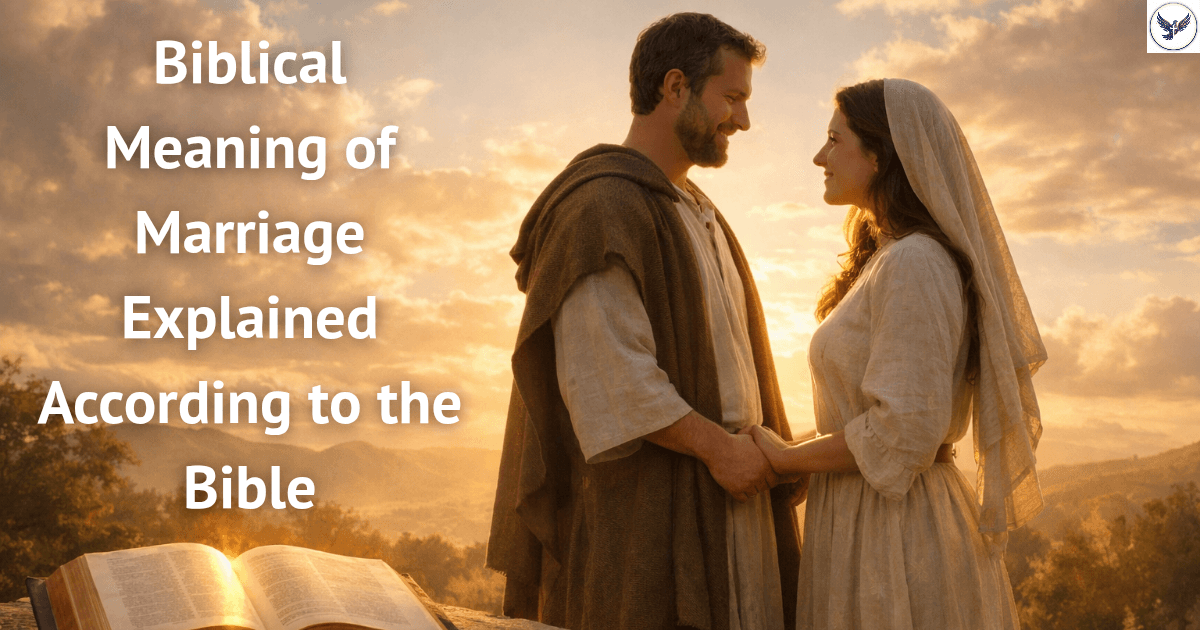
Marriage is often seen as a legal agreement or a social tradition, but spiritually it is understood as something much deeper. In many beliefs, marriage is considered a sacred union that connects two lives at a deeper level.
For some people, marriage is mainly about commitment and responsibility. But from a spiritual perspective, it is often seen as a covenant a bond built on love, faith, and a purpose guided by God.
This connection is not only about living together but also about growing together, supporting each other, and becoming stronger emotionally and spiritually.
In marriage, two individuals come together in unity while still keeping their own identity. It becomes a journey that teaches patience, forgiveness, and unconditional love.
Many spiritual and biblical perspectives also suggest that marriage has a higher purpose. It can guide both partners toward emotional healing and spiritual growth.
In this article, we will explore the deeper spiritual meaning of marriage, its biblical foundation, its purpose in personal growth, and how it helps build a meaningful and God-cantered life.

What Is the Spiritual Meaning of Marriage?
The spiritual meaning of marriage is much deeper than just living together or sharing responsibilities. It is a sacred bond where two people come together not only physically and emotionally, but also spiritually.
Marriage is about unity where two people become one while still continuing to grow as individuals. It is a journey where both partners learn love, patience, forgiveness, and faith through everyday life.
Spiritually, marriage is seen as a covenant, not just a contract. This means it is built on commitment, trust, and a deeper purpose guided by God. It is not only about happiness, but also about growing together through challenges and becoming better people.
Marriage teaches people how to love unconditionally and support each other in both good times and difficult moments.
The Bible beautifully explains this unity:
“The two will become one flesh.” — Genesis 2:24
This verse shows that marriage is meant to be a complete union heart, mind, and soul. In a spiritual sense, marriage helps both partners move closer to God while building a strong and meaningful life together.

The 7 Pillars of a Strong and Spiritual Marriage
A strong and spiritual marriage is not built by chance it is built on intentional choices, guided by faith and grounded in God’s truth. In a Christian marriage, the relationship is not just between two people, but also with God at the centre.
These seven pillars form the foundation of a marriage that is stable, meaningful, and spiritually strong.
Also Read : There Is No Marriage in Heaven? Bible Explained
1. The Foundation of Christ (The Chief Cornerstone)
A spiritual marriage must be built on Jesus Christ, not just human effort. He is the perfect example of love, sacrifice, and forgiveness. When both husband and wife grow closer to God, they naturally grow closer to each other.
“Everyone who hears these words of mine and puts them into practice is like a wise man who built his house on the rock.” — Matthew 7:24
2. Covenant, Not Contract (Unshakable Commitment)
Marriage is not a temporary agreement it is a sacred covenant before God. Unlike a contract that depends on conditions, a covenant is built on lifelong commitment. It means staying together through every season, trusting God to guide the relationship.
“Therefore what God has joined together, let no one separate.” — Mark 10:9
3. Sacrificial Love (Agape in Action)
True love in marriage goes beyond feelings. It is a choice to love selflessly, even when it’s difficult. This kind of love reflects how Christ loves us—patiently, kindly, and without conditions.
“Love is patient, love is kind… Love never fails.” — 1 Corinthians 13:4–8
4. Radical Forgiveness (Grace Extended)
No marriage is perfect, and mistakes will happen. What keeps a marriage strong is the ability to forgive quickly and sincerely. Letting go of hurt brings healing and restores peace in the relationship.
“Forgiving each other, just as in Christ God forgave you.” — Ephesians 4:32
5. Intentional Communication (Truth with Grace)
Healthy communication is essential for a strong marriage. It means speaking honestly but kindly, and listening with patience. Words should build connection, not create distance.
“Let your conversation be always full of grace.” — Colossians 4:6
6. Spiritual Intimacy (Growing Together in Faith)
Spiritual intimacy strengthens the bond between husband and wife. Praying together, reading Scripture, and seeking God as a couple brings unity and peace into the marriage.
“For where two or three gather in my name, there am I with them.” — Matthew 18:20
7. Shared Purpose (Living for God Together)
Marriage is not only about personal happiness—it also has a greater purpose. When couples serve God together and align their lives with His will, their relationship gains deeper meaning and direction.
“As for me and my household, we will serve the Lord.” — Joshua 24:15
A marriage built on these seven pillars becomes more than just a relationship it becomes a reflection of God’s love, grace, and purpose in everyday life.
You can also try our Dream Interpretation Tool to understand your dream more clearly.
Marriage as a Divine Covenant (Not Just a Contract)
Marriage, from a spiritual and biblical perspective, is not just a legal agreement it is a divine covenant. While a contract is based on conditions (“I will do my part if you do yours”), a covenant is built on unconditional commitment.
It is a sacred promise made not only between two people but also before God. This means marriage is meant to be lasting, faithful, and rooted in something deeper than circumstances or emotions.
In a contract mindset, people often look for ways out when things become difficult. But in a covenant, the focus shifts from “me” to “we.” It calls for patience, sacrifice, and trust, even during challenges.
A covenant reflects God’s own faithfulness He does not abandon His promises, and marriage is meant to mirror that same enduring love.
The Bible clearly highlights this sacred bond:
“Therefore what God has joined together, let no one separate.” — Mark 10:9
This verse reminds us that marriage is not just a human decision but a union blessed and joined by God Himself. When couples understand marriage as a covenant, they begin to approach it with deeper respect, commitment, and spiritual purpose.

What Does the Bible Say About Traditional Marriage?
The Bible presents traditional marriage as a sacred and purposeful union designed by God from the very beginning. It is not just a cultural practice but,
A divine plan where a man and a woman come together in commitment, love, and unity. In Scripture, marriage is shown as the foundation of family life and a relationship built on faith, respect, and mutual care.
From the creation story, we see God’s design clearly. He created man and woman to complement each other and live in unity:
“Therefore a man shall leave his father and mother and be joined to his wife, and they shall become one flesh.” — Genesis 2:24
This verse highlights that marriage is meant to be a deep, lifelong bond where two individuals become one in purpose and spirit. Traditional marriage in the Bible is not only about companionship but also about partnership—supporting each other, building a family, and walking together in faith.
The Bible also emphasizes roles rooted in love and respect. Husbands are called to love their wives with a selfless and sacrificial love, just as Christ loves the Church, while wives are encouraged to respect and support their husbands.
“Husbands, love your wives, just as Christ loved the church and gave himself up for her.” — Ephesians 5:25
At its core, traditional marriage in the Bible is about unity, faithfulness, and living according to God’s will. It is a relationship that reflects God’s love strong, enduring, and centered on spiritual purpose rather than just personal desire.
Marriage in Different Spiritual Perspectives
Marriage is understood differently across cultures and spiritual traditions, yet one common theme remains—it is seen as a meaningful and often sacred union. Below is a simple comparison of how various perspectives view the purpose and meaning of marriage.
|
Perspective |
Meaning of Marriage |
Key Focus |
Spiritual Element |
|
Christianity |
A sacred covenant before God |
Love, commitment, faith |
Reflects Christ and the Church |
|
Hinduism |
A holy duty (Dharma) and lifelong bond |
Family, responsibility, tradition |
Considered a sacred sacrament (Sanskara) |
|
Islam |
A solemn contract with spiritual value |
Partnership, protection, mutual rights |
Act of worship and obedience to God |
|
Buddhism |
A personal choice, not a religious requirement |
Harmony, understanding, compassion |
Focus on ethical living and balance |
|
Spiritual (General) |
A soul connection for growth |
Emotional and spiritual development |
Inner transformation and life lessons |
|
Modern View |
A partnership based on love and choice |
Equality, companionship |
Personal fulfillment and mutual support |
While the interpretations may vary, most perspectives agree that marriage is more than just a social arrangement. It carries emotional, moral, and often spiritual significance. Whether seen as a covenant, duty, or partnership, marriage plays a powerful role in shaping individuals and their life journey.

Symbolism of Husband and Wife Union
The union of husband and wife carries deep spiritual symbolism that goes far beyond a physical relationship. It represents unity, balance, and a divine connection designed by God. In a spiritual sense, marriage reflects how two different individuals come together to form one complete and meaningful partnership.
At its core, this union symbolizes oneness. The Bible describes this beautifully:
“The two shall become one flesh.” — Genesis 2:24
This does not mean losing individuality, but rather joining in purpose, love, and direction. Husband and wife are meant to support, strengthen, and complement each other in every aspect of life.
Key Symbolic Meanings of Husband and Wife Union
- Unity in diversity and purpose
- Balance of strength and gentleness
- Partnership in life and faith
- Mutual support and understanding
- Reflection of divine love
- Emotional and spiritual connection
- Growth through shared journey
Spiritually, the husband and wife union also reflects the relationship between Christ and the Church. It is a bond built on love, sacrifice, and commitment. The husband is often seen as a protector and guide, while the wife brings nurturing, wisdom, and emotional strength—together creating harmony.
This union is not about control or dominance, but about working together as one team. Each person brings unique qualities, and when these are combined with love and respect, the relationship becomes stronger and more balanced.
In a deeper sense, marriage symbolizes a journey of transformation. Through this union, both individuals grow spiritually, learn patience, and experience unconditional love. It becomes a reflection of God’s design where love is not just felt, but lived every day.

Challenges in Marriage and Their Spiritual Meaning
Every marriage faces challenges it is a natural part of sharing life with another person. But from a spiritual perspective, these difficulties are not just problems; they are opportunities for growth, healing, and deeper connection.
Challenges in marriage often reveal what needs attention within us, helping both partners grow in patience, love, and faith.
Instead of seeing struggles as signs of failure, they can be viewed as part of God’s process to strengthen the relationship. Just as gold is refined through fire, marriages are often strengthened through trials.
“Consider it pure joy… whenever you face trials of many kinds, because you know that the testing of your faith produces perseverance.” — James 1:2–3
Common Challenges and Their Spiritual Meaning
- Miscommunication → Learning understanding and patience
- Conflicts → Opportunity for growth and maturity
- Emotional distance → Need for reconnection and honesty
- Trust issues → Building deeper faith and transparency
- Financial stress → Learning dependence on God
- Ego clashes → Letting go of pride and control
- Routine and boredom → Renewing love with intention
Spiritually, these challenges help uncover hidden emotions, past wounds, and personal weaknesses. They invite both partners to grow not just individually, but together. Marriage becomes a mirror, showing areas where healing and change are needed.
The Bible encourages couples to remain patient and loving even during difficult times:
“Be completely humble and gentle; be patient, bearing with one another in love.” — Ephesians 4:2
When couples face challenges with a spiritual mindset, they stop asking, “Why is this happening to us?” and start asking, “What is this teaching us?” This shift brings wisdom, strengthens the bond, and deepens the relationship.
In the end, challenges are not meant to break a marriage they are meant to refine it, bringing both partners closer to each other and to God.

How to Get Married According to the Bible
The Bible does not describe a single fixed wedding ceremony or step-by-step ritual for marriage. Instead, it provides principles and guidance that shape a God-centered and meaningful union. Biblical marriage focuses more on the heart, commitment, and covenant before God than on external traditions.
1. Seek God’s Guidance First
A biblical marriage begins with seeking God’s will. Before entering marriage, both individuals should pray and ask for wisdom, clarity, and direction. A relationship rooted in God starts with spiritual alignment.
“Trust in the Lord with all your heart… and He will make your paths straight.” — Proverbs 3:5–6
2. Choose a God-Centered Partner
The Bible encourages believers to marry someone who shares their faith and values. Spiritual unity creates a stronger foundation and helps both partners grow together in their relationship with God.
“Do not be unequally yoked with unbelievers.” — 2 Corinthians 6:14
3. Leave and Cleave (Commit Fully)
Marriage requires a new level of commitment. The Bible teaches that a person leaves their parents and forms a new, primary bond with their spouse. This represents emotional and spiritual independence.
“A man shall leave his father and mother and be united to his wife.” — Genesis 2:24
4. Make a Covenant Before God
Marriage is a sacred covenant, not just a social agreement. It involves making a lifelong promise before God to love, honor, and remain faithful to one another through all circumstances.
“Though one may be overpowered, two can defend themselves… a cord of three strands is not quickly broken.” — Ecclesiastes 4:12
5. Honor and Love Each Other
The Bible calls husbands and wives to treat each other with love, respect, and care. A biblical marriage is built on mutual honor and selfless love.
“Above all, love each other deeply.” — 1 Peter 4:8
6. Live in Faithfulness and Purity
Marriage is meant to be a faithful and exclusive relationship. The Bible emphasizes purity before and within marriage, encouraging couples to honor God in their actions and choices.
“Marriage should be honored by all, and the marriage bed kept pure.” — Hebrews 13:4
7. Build a Life Together with God at the Center
A biblical marriage continues to grow through prayer, faith, and shared purpose. Couples are encouraged to walk together with God daily, strengthening their bond spiritually and emotionally.
“As for me and my household, we will serve the Lord.” — Joshua 24:15
In the Bible, marriage is less about a ceremony and more about a lifelong commitment rooted in faith, love, and obedience to God. When couples follow these principles, they build a strong, meaningful, and spiritually grounded marriage.

Core Biblical Truth
Marriage Is God’s Covenant, Not a Contract
In the Bible, marriage is a sacred covenant witnessed by God, built on lifelong faithfulness, unity, and selfless love rather than temporary emotions or convenience.

Also Read : What Do Moles on Face Mean Spiritually? Female & Male Meaning Explained
Signs Your Marriage Has a Spiritual Purpose
When a marriage is rooted in Christ, it becomes more than just a lifelong partnership it becomes a ministry. A spiritual marriage doesn’t just look inward at its own happiness; it looks outward to see how God can use the relationship for His kingdom.
Here are a few key signs that your marriage is operating with a divine, spiritual purpose:
- You Pray Together and for Each Other: Prayer isn’t just a last resort during crises; it is a daily rhythm. You bring your anxieties, decisions, and gratitude to God as a unified front.
- You Serve Others as a Team: Whether it is volunteering at church, hosting a Bible study, or simply offering hospitality and a listening ear to neighbors, your home is a beacon of light and warmth to those around you.
- Conflicts Lead to Growth, Not Resentment: Disagreements will happen, but instead of keeping score, you use conflict as a tool for sanctification. You practice quick forgiveness, humble apologies, and extending the same grace God extends to you.
- You Encourage Each Other’s Spiritual Gifts: You actively look for how God has uniquely gifted your spouse and encourage them to use those talents for His glory, cheering them on in their individual walk with faith.
The Bible beautifully illustrates the strength and purpose of a marriage that includes God at the center:
“Though one may be overpowered, two can defend themselves. A cord of three strands is not quickly broken.” > — Ecclesiastes 4:12
When God is that third strand, your marriage is fortified not just to survive the storms of life, but to serve a much higher, eternal calling.
God’s Original Design
Marriage Was Created Before Sin
Marriage existed in God’s perfect creation before sin entered the world, showing it was designed as a blessing for companionship, family, and spiritual growth.
Conclusion:
The spiritual meaning of marriage goes far beyond love, tradition, or companionship it is a sacred journey of growth, unity, and purpose.
When seen through a spiritual and biblical lens,
marriage becomes a covenant rooted in faith, shaped by challenges, and strengthened through love and commitment. It is not about perfection, but about learning, evolving, and walking together through every season of life.
A strong marriage is built on deeper values faith in God, forgiveness, patience, and mutual support. Through both joyful and difficult moments, couples are given the opportunity to grow closer not only to each other but also to God.
In the end, marriage is not just about finding the right person it is about becoming the right partner and building a life that reflects love, grace, and purpose every day.
FAQ’s:
-
Why does God allow challenges in marriage?
Challenges in marriage are often part of spiritual growth. They help couples learn important lessons, strengthen their bond, and build a deeper understanding of love and faith.
-
What are the signs of a spiritually strong marriage?
A spiritually strong marriage shows growth, mutual support, deep connection, forgiveness, and a sense of peace even during difficult times. Both partners feel guided and supported in their journey.
-
What are the main purposes of marriage in the Bible?
The Bible highlights several purposes of marriage, including companionship, unity, building a family, spiritual growth, and reflecting God’s love through the relationship.
-
Does the Bible define traditional marriage?
Yes, the Bible describes marriage as a union between a man and a woman, rooted in love, commitment, and faith. It emphasizes unity, respect, and a lifelong bond guided by God’s principles.

I am Niranjan Joshi, the founder and writer of Meaningful Spirits. Through this website, I research and write about biblical meanings, Christian dream interpretation, and spiritual reflections to help readers understand deeper spiritual messages and grow in faith.